

Critical path analysis in project management is a scheduling technique used to identify the longest sequence of dependent tasks and determine the shortest possible time needed to complete a project. It helps project managers understand which activities directly affect deadlines and where delays may occur.
By identifying the critical path, teams can prioritize tasks, manage dependencies, allocate resources, and improve project scheduling. This guide explains how critical path analysis works, its main benefits, and how to calculate the critical path using practical examples, network diagrams, and forward and backward pass calculations.
Why this optimization works: The introduction provides a direct definition in the first sentence, naturally integrates the primary keyword, and previews the most valuable content without unnecessary promotional language.

- Collaborate from every device
- Automate tasks and workflows
- See all projects at a glance
- Make quotes in minutes
What is Critical Path Analysis in Project Management?
Critical path analysis (CPA) in project management is a scheduling technique that identifies the longest sequence of dependent activities required to complete a project. This sequence, known as the critical path, determines the minimum project duration based on the estimated time needed for each task.
In simple terms, the critical path analysis definition refers to identifying the tasks that cannot be delayed without affecting the project’s completion date, assuming the schedule remains unchanged.
For example, in a video production project, filming must be completed before certain editing tasks can begin, and the final edit must be approved before delivery. If these activities are on the critical path, delaying one can push back the entire production schedule.
Critical path analysis helps project managers:
- Predict project completion dates by calculating the duration of dependent activities.
- Identify critical tasks and dependencies that directly influence project deadlines.
- Prioritize resources for time-sensitive activities.
- Identify scheduling flexibility by calculating float or slack for non-critical tasks.
- Monitor project progress and respond to delays before they affect delivery.
Understanding critical path analysis is an important part of effective project planning management, helping teams organize activities, manage dependencies, and create more realistic project schedules.
Key Terms Used in Critical Path Analysis
Understanding the key terms used in critical path analysis helps project managers calculate task durations, identify dependencies, and determine which activities directly affect project completion.
The essential terms include:
- Task (Activity): An individual piece of work that must be completed as part of the project.
- Dependency: A relationship between tasks that determines the order in which activities must occur.
- Task Duration: The estimated time required to complete an activity.
- Critical Path: The longest sequence of dependent tasks that determines the minimum time needed to complete a project.
- Float (Slack): The amount of time an activity can be delayed without affecting the overall project completion date.
- Earliest Start (ES): The earliest time a task can begin, considering its dependencies.
- Earliest Finish (EF): The earliest time a task can finish based on its earliest start and duration.
- Latest Start (LS): The latest time a task can begin without delaying the scheduled project completion.
- Latest Finish (LF): The latest time a task can finish without delaying the scheduled project completion.
Tasks on the critical path generally have zero total float, meaning that delays to these activities can directly affect the project timeline. These terms form the foundation for calculating the critical path using network diagrams, forward-pass calculations, and backward-pass calculations.
Why this optimization works: The original glossary already covers the core concepts, so we preserve them while adding Task Duration, Earliest Finish, and Latest Start. These additions make the glossary more complete and prepare readers for the existing calculations later in the article.
Why Is Critical Path Analysis Important in Project Management?
Critical path analysis is important in project management because it helps teams identify activities that directly affect project completion dates. By understanding which tasks have no scheduling flexibility, project managers can prioritize resources, anticipate delays, and make better decisions about project timelines.
The main benefits of critical path analysis include:
- Accurate Project Duration Prediction: Identifying the longest sequence of dependent tasks helps determine the minimum time required to complete a project.
- Early Identification of Bottlenecks: Critical tasks highlight where delays could directly affect the project completion date.
- Better Resource Allocation: Teams can prioritize people, equipment, and other resources for activities that directly influence project deadlines.
- Improved Project Scheduling: Understanding dependencies and float helps managers organize activities more efficiently.
- Enhanced Team Collaboration: Clear task priorities and responsibilities help team members coordinate their work and focus on important deadlines.
Effective critical path analysis also supports better personnel management by helping managers coordinate people and assign resources according to project priorities.
This becomes particularly important for distributed teams, where the challenges of virtual teams can make communication, task coordination, and deadline management more difficult.
For example, when a creative agency is managing several client projects, critical path analysis helps identify which tasks require immediate attention and which activities have scheduling flexibility without affecting delivery dates.
How to Identify the Critical Path in Project Management: Step-by-Step Guide
To identify the critical path in project management, list all project activities, estimate their durations, define task dependencies, and calculate the earliest and latest start and finish times. The longest sequence of dependent tasks determines the minimum project duration.
Follow these seven steps to perform critical path analysis:
- List All Project Tasks: Break the project into individual activities using a work breakdown structure (WBS). Include every task required to complete the project.
- Estimate Task Durations and Dependencies: Determine how long each activity will take and identify which tasks must be completed before others can begin.
- Create a Project Network Diagram: Represent tasks and their dependencies visually to understand the sequence of activities and identify possible paths through the project.
- Perform the Forward Pass: Calculate the Earliest Start (ES) and Earliest Finish (EF) of each task, beginning with the first activity and moving toward project completion.
- Perform the Backward Pass: Calculate the Latest Finish (LF) and Latest Start (LS) for each activity by working backward from the scheduled project completion time.
- Calculate Float or Slack: Determine the scheduling flexibility of each activity using the formula:
Total Float = Latest Start (LS) − Earliest Start (ES)
Alternatively:
Total Float = Latest Finish (LF) − Earliest Finish (EF) - Identify the Critical Path: Find the longest sequence of dependent activities. In a standard unconstrained critical path calculation, activities on the critical path have zero total float and determine the minimum project duration.
Once the critical path is identified, project managers can focus on time-sensitive activities, adjust resource allocation, and monitor tasks that could delay project delivery.
The following example demonstrates how to determine the critical path using a project network diagram, followed by practical forward-pass and backward-pass calculations.
Example: Determining the Critical Path Method with a Project Diagram
To better understand critical path analysis in project management, let’s walk through a simple example with a visual diagram illustrating task sequences and durations.

The project begins at the green circle labeled “Start.”
There are several tasks with their respective durations:
- Task A: 3 days
- Task B: 2 days
- Task C: 4 days
- Task D: 3 days
- Task E: 3 days
The arrows between tasks indicate the order in which tasks must be completed. For instance, Task A must be finished before Task D begins, and Task B must be completed before Task C starts.
The goal is to reach the Finish point, represented by the orange circle.
How the Critical Path Method is Determined:
By examining all possible paths from Start to Finish, we calculate their total durations:
- Start → Task A → Task D → Task E → Finish:
3 days + 3 days + 3 days = 9 days - Start → Task B → Task C → Finish:
2 days + 4 days = 6 days - Start → Task A → Finish (direct path):
3 days
The longest path in terms of duration is the critical path because it determines the total time required to complete the project.
How This Affects Your Project Timeline?
The critical path is Start → Task A → Task D → Task E → Finish, totaling 9 days.
This means that any delay in Task A, Task D, or Task E will directly delay the entire project completion.
Tasks B and C, not being on the critical path, have some scheduling flexibility and can be delayed without impacting the overall project timeline.
Visualizing Forward and Backward Pass Calculations
Understanding the forward and backward pass is central to mastering critical path analysis in project management. These calculations help determine the earliest and latest times tasks can start and finish without delaying the project.
Imagine a simple project with three tasks:
- Task A: Duration 3 days, no dependencies (start task)
- Task B: Duration 4 days, depends on Task A
- Task C: Duration 2 days, depends on Task B
Forward Pass:
The forward pass calculates the earliest start (ES) and earliest finish (EF) times for each task, moving from the project start to finish:
- Task A ES = Day 0, EF = 3
- Task B ES = Day 3, EF = 7
- Task C ES = Day 7, EF = 9
Backward Pass:
The backward pass calculates the latest finish (LF) and latest start (LS) times, moving backward from the project’s end:
- Task C LF = Day 9, LS = 7
- Task B LF = Day 7, LS = 3
- Task A LF = Day 3, LS = 0
Float (Slack) Calculation:
Float = LS – ES (or LF – EF) for each task:
- Task A Float = 0
- Task B Float = 0
- Task C Float = 0
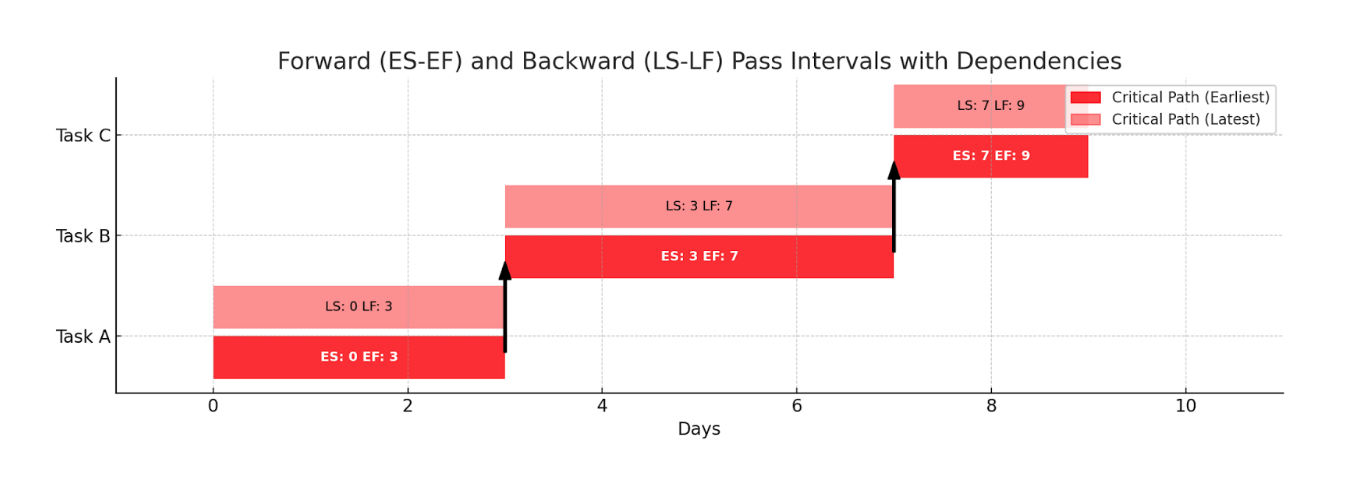
Since all tasks have zero float, they all lie on the critical path.
This simple example shows how the forward and backward passes help identify the tasks that directly impact the project timeline.
Visualizing the Critical Path for Better Communication
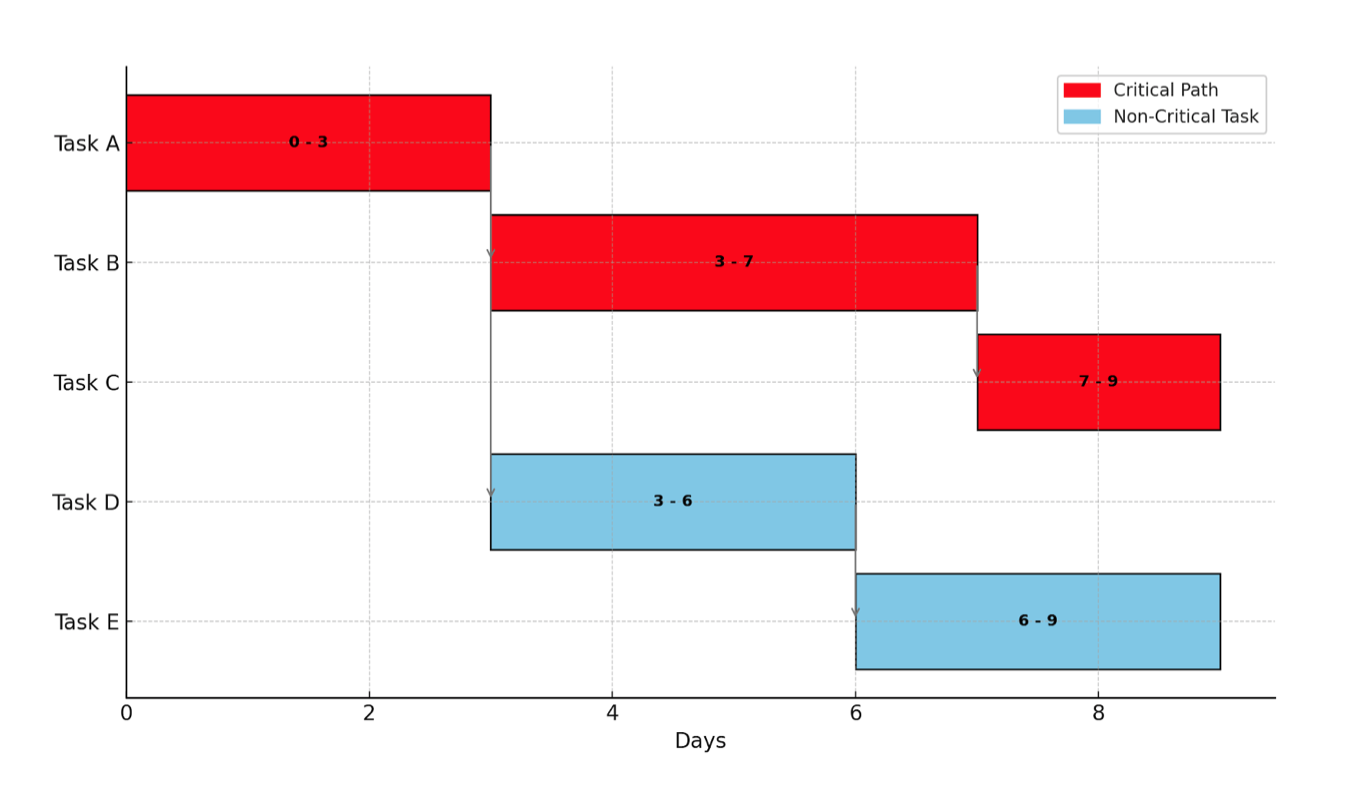
Visualizing the critical path helps project managers and team members understand task dependencies, identify time-sensitive activities, and communicate project priorities. By presenting project schedules visually, teams can see which tasks directly affect delivery dates and where scheduling flexibility exists.
Common Visualization Tools
Two commonly used tools for visualizing critical path analysis are:
- Gantt Charts: Horizontal bar charts that display task durations, start and end dates, and dependencies. Critical path activities can be highlighted to show which tasks require close monitoring.
- PERT/Network Diagrams: Visual representations of project activities and their relationships. These diagrams show how tasks connect and help identify the longest sequence of dependent activities.
Benefits of Visualization
Visualizing the critical path offers several advantages:
- Improved Communication: Helps stakeholders understand project schedules, dependencies, and priorities.
- Clearer Task Priorities: Makes it easier to identify which activities require immediate attention.
- Better Coordination: Helps teams organize dependent tasks and communicate scheduling changes.
- Faster Identification of Delays: Makes it easier to see how changes to critical activities may affect project completion.
- More Effective Project Monitoring: Supports regular schedule reviews as tasks progress and project requirements change.
Using visual representations of the critical path makes project planning more transparent and helps teams coordinate their work around shared deadlines.
Creating a clear project timeline also helps teams visualize task durations, dependencies, milestones, and deadlines throughout the project.
Common Critical Path Analysis Mistakes and How to Avoid Them
Common mistakes in critical path analysis include overlooking task dependencies, failing to update project schedules, miscalculating float, and not communicating critical priorities. These errors can lead to unrealistic timelines, scheduling conflicts, and unexpected project delays.
Understanding these challenges helps project managers maintain an accurate and reliable critical path.
Ignoring Task Dependencies
Failing to identify relationships between activities can result in inaccurate project schedules. For example, scheduling video editing before the required footage is available can create unrealistic delivery expectations.
How to avoid it: Review task dependencies before calculating the critical path and confirm the sequence of activities with the relevant team members.
Not Updating the Critical Path Regularly
The critical path can change as project activities progress. Delays, changes in task durations, or additional dependencies can create a different critical sequence.
How to avoid it: Reassess the critical path when project timelines, resources, or requirements change.
Overlooking Float or Slack
Ignoring float can make it difficult to distinguish between activities that directly affect the project completion date and those with scheduling flexibility.
How to avoid it: Calculate total float for each activity and use this information when prioritizing tasks and allocating resources.
Poor Communication About Critical Tasks
When team members do not understand which activities are on the critical path, they may focus on less urgent work while time-sensitive tasks remain incomplete.
How to avoid it: Clearly communicate critical task priorities, dependencies, responsibilities, and deadlines.
Using Unrealistic Task Duration Estimates
Inaccurate duration estimates can produce unreliable project completion dates and hide potential scheduling risks.
How to avoid it: Base estimates on previous project experience, available resources, and input from the people responsible for completing the work.
By avoiding these mistakes, project managers can improve schedule accuracy, reduce unnecessary delays, and make critical path analysis more useful throughout the project lifecycle.
How Critical Path Analysis Improves Resource Scheduling and Team Collaboration
Critical path analysis improves resource scheduling and team collaboration by helping project managers identify time-sensitive activities, coordinate dependent tasks, and allocate available resources according to project priorities.
Understanding which tasks directly affect the completion date allows managers to organize workloads more effectively and reduce scheduling conflicts.
Key ways critical path analysis supports resource scheduling include:
- Strategic Resource Allocation: Prioritize people, equipment, and other resources for activities that directly influence project deadlines.
- Coordinated Team Efforts: Help team members understand task dependencies, responsibilities, and the order in which work must be completed.
- Preventing Scheduling Conflicts: Identify competing resource requirements and adjust assignments to avoid overlapping commitments.
- Real-Time Adaptation: Review task dependencies and update project schedules when deadlines, resources, or priorities change.
- Better Workload Management: Use available float to identify opportunities for rescheduling non-critical activities without delaying overall project completion.
Managing overlapping assignments and shifting priorities also requires strong multitasking skills, particularly when teams are working on several projects simultaneously.
For agencies working with changing client requirements and multiple deadlines, effective creative project management helps teams coordinate tasks, manage feedback, and keep projects moving forward.
Example: Managing Resource Conflicts in a Project
Consider a media production project where two important tasks require the same specialist at the same time.
If both tasks are scheduled simultaneously, the resource conflict may delay project progress.
Critical path analysis helps the project manager identify which activities are time-sensitive and assess whether other tasks have enough float to be rescheduled. The manager can then adjust assignments, find additional resources, or revise the schedule.
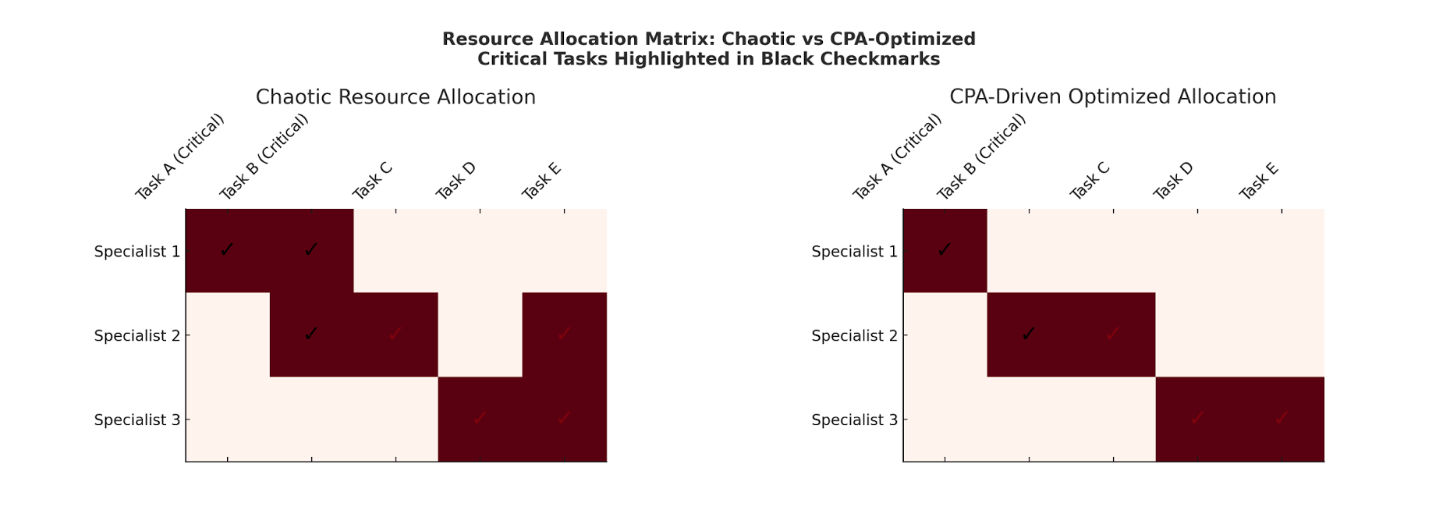
The existing resource allocation matrix illustrates this situation:
- Left: Overlapping assignments create conflicts, with Task A and Task B competing for Specialist 1.
- Right: Adjusted resource allocation reduces conflicts and gives priority to time-sensitive activities.
Critical path analysis does not automatically resolve resource conflicts, but it provides the scheduling information needed to make better resource allocation decisions.
Combining critical path analysis with clear task assignments and regular communication helps teams coordinate work and respond more effectively to changing project requirements.
When to Reassess the Critical Path
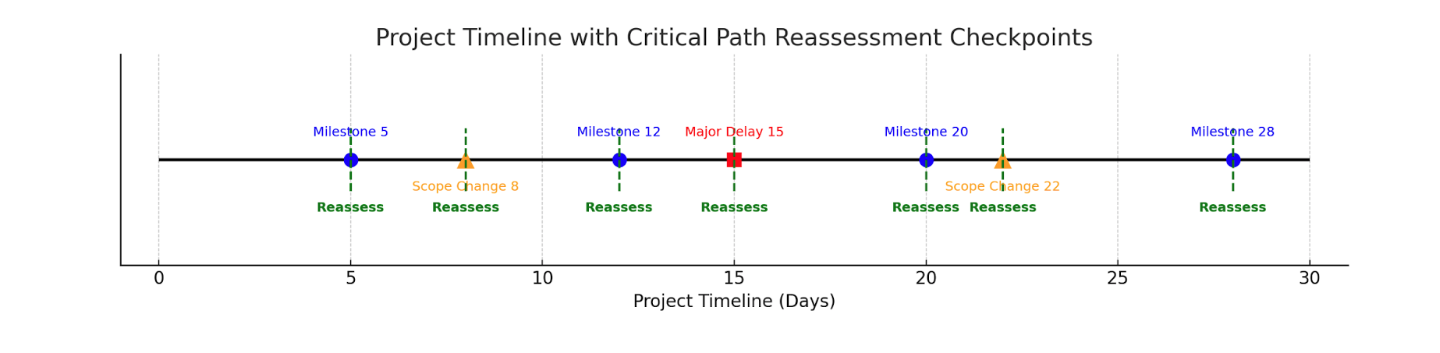
The critical path should be reassessed whenever changes to task durations, dependencies, resources, or project scope could affect the planned completion date. A project’s critical path is not always fixed, and activities that were previously non-critical may become critical as the schedule changes.
Project managers should review the critical path when:
- Task Durations Change: Delays or faster-than-expected completion times affect the sequence or timing of activities.
- New Tasks or Dependencies Appear: Additional requirements change how project activities relate to one another.
- Resource Availability Changes: Team members, equipment, or other resources become unavailable or are reassigned.
- Project Scope Evolves: New deliverables or revised requirements affect the original schedule.
- Scheduling Conflicts Occur: Competing resource needs create delays or require changes to task assignments.
For example, if a non-critical task uses up its available float because of an unexpected delay, it may become part of the critical path.
Regularly reviewing task progress and recalculating the critical path when necessary helps project managers maintain realistic schedules, identify emerging risks, and respond before delays affect project delivery.
Advanced Critical Path Analysis Techniques
Advanced critical path analysis helps project managers handle complex schedules, multiple critical paths, changing priorities, and project risks. While the basic method identifies the longest sequence of dependent activities, more complex projects may require additional planning and regular schedule adjustments.
Managing Multiple Critical Paths
A project can have more than one critical path when multiple sequences of activities have the same longest duration.
In this situation, delays to any of these critical paths can affect the overall project completion date. Project managers need to monitor all critical sequences rather than focusing on a single path.
Using Critical Path Analysis in Agile and Hybrid Projects
Critical path analysis can complement Agile and hybrid project management approaches when teams need to coordinate dependencies or meet fixed delivery deadlines.
For example, a media production team using a hybrid workflow may follow an iterative review process while maintaining a fixed final delivery date. Understanding critical dependencies helps the team coordinate activities that must happen in a particular sequence.
Integrating Critical Path Analysis With Risk Management
Critical path analysis helps project managers identify activities where delays could directly affect delivery dates.
Combining this information with risk assessments, contingency plans, and appropriate schedule buffers can help teams prepare for disruptions.
For complex projects, regularly reviewing critical paths, resource availability, and scheduling risks supports more realistic planning and better decision-making.
Benefits of Mastering Critical Path Analysis in Project Management
Mastering critical path analysis helps project managers turn scheduling information into practical decisions that improve project delivery and team coordination.
By regularly applying critical path analysis, project managers can:
- Meet Deadlines More Consistently: Identify time-sensitive activities and address scheduling risks before they affect project completion.
- Communicate Project Progress Clearly: Keep stakeholders informed about critical tasks, dependencies, and potential delays.
- Reduce Project Risks: Anticipate scheduling problems and prepare contingency plans for important activities.
- Optimize Resource Utilization: Prioritize available resources according to task dependencies and project deadlines.
- Make Better Project Decisions: Use task duration estimates, float calculations, and schedule updates to guide planning and resource allocation.
These benefits make critical path analysis a valuable technique for managing complex projects and maintaining better visibility over project timelines.
What Is the Difference Between Critical Path Analysis and the Critical Path Method?
Critical path analysis (CPA) and the critical path method (CPM) are closely related terms that are often used interchangeably in project management. Both focus on identifying the longest sequence of dependent activities that determines the minimum project duration.
The critical path method refers to the structured scheduling technique used to calculate the critical path, while critical path analysis generally describes the process of examining project activities, dependencies, durations, and scheduling flexibility.
| Critical Path Analysis (CPA) | Critical Path Method (CPM) |
| Emphasizes analyzing the project schedule and identifying critical activities. | Refers to the structured method used to calculate the critical path. |
| Helps project managers understand task dependencies and scheduling risks. | Uses task durations, dependencies, forward and backward passes, and float calculations. |
| Supports project monitoring and scheduling decisions. | Provides the calculations needed to determine the minimum project duration. |
In practice, both terms describe closely connected aspects of critical path scheduling and are frequently used to mean the same thing.
How Cirkus Supports Project Scheduling and Team Collaboration
Critical path analysis helps project managers identify important task dependencies and scheduling priorities. Once these priorities are established, teams need clear workflows, task assignments, and regular communication to keep projects moving forward.
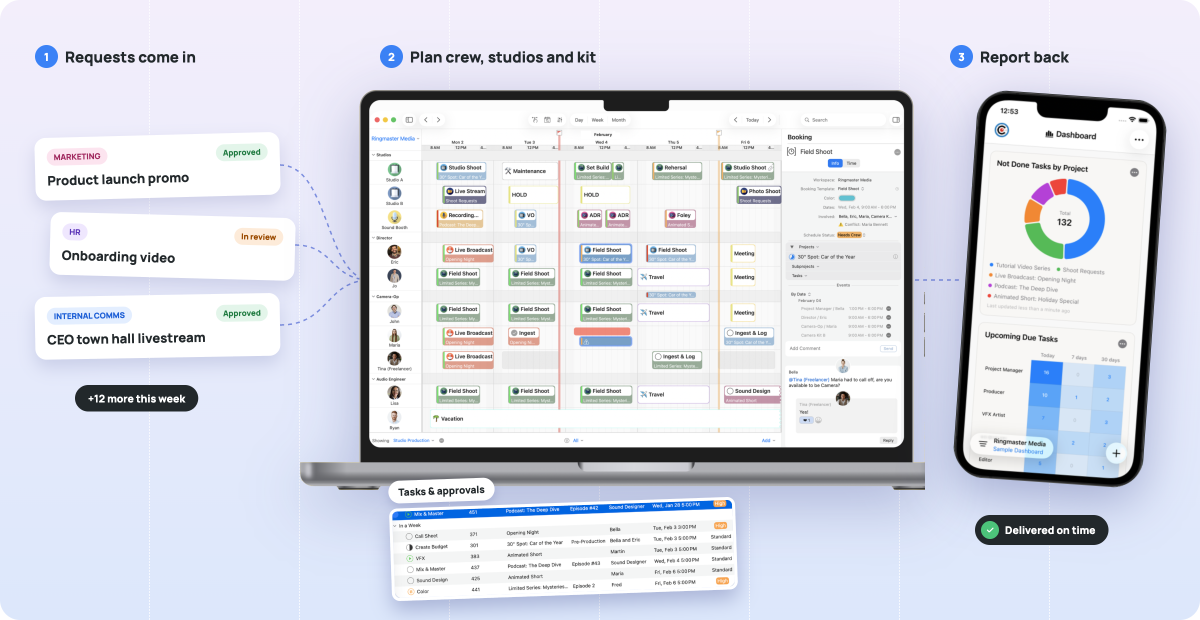
Cirkus is a collaborative project management platform that helps teams organize tasks, coordinate schedules, and track progress across shared projects.
With Cirkus, teams can:
- Organize Project Tasks: Keep activities and responsibilities structured in a shared workspace.
- Coordinate Task Dependencies: Plan connected activities and communicate the order in which work needs to be completed.
- Improve Team Collaboration: Keep team members informed about responsibilities, deadlines, and project updates.
- Track Project Progress: Maintain visibility into ongoing activities and identify tasks requiring attention.
- Manage Changing Priorities: Update assignments and workflows when project requirements change.
For creative agencies and production teams, effective project management in the media industry requires clear schedules, task responsibilities, and coordination across different production stages. Cirkus helps teams organize these activities in one shared workspace.
Explore the Cirkus app to see how it can support your team’s project planning and daily workflows.
Conclusion
Critical path analysis in project management helps teams identify time-sensitive activities, understand task dependencies, and determine the minimum time required to complete a project.
By calculating the critical path, monitoring float, and regularly reviewing project schedules, project managers can make better decisions about deadlines, resources, and potential delays.
For creative agencies, media production teams, and other businesses managing complex workflows, combining critical path analysis with effective project coordination helps keep tasks organized and teams aligned.
Cirkus supports this process by helping teams manage tasks, coordinate schedules, and track project progress in a shared workspace.
Explore Cirkus to simplify project planning, improve team collaboration, and keep your projects moving forward.
Frequently Asked Questions About Critical Path Analysis