

Critical path analysis in project management is a powerful technique that helps project managers identify the longest sequence of dependent tasks and determine the shortest possible project duration. Mastering this method ensures projects are completed on time by highlighting the tasks that directly impact the project timeline.
In this article, we will explore what critical path analysis in project management is, why it is essential, and how to perform it step-by-step. We will also discuss common challenges and how CPA supports efficient scheduling and resource planning, aligning naturally with modern project management tools like Cirkus without being promotional.
What is Critical Path Analysis in Project Management?
At its core, critical path analysis in project management is a scheduling technique used to identify the longest stretch of dependent activities and measure the time required to complete them from start to finish, which is a crucial part of effective project planning management that ensures tasks are sequenced properly.
Understanding this method helps project managers:
- Accurately predict project completion dates
- Identify task dependencies and bottlenecks
- Allocate resources efficiently
- Monitor and control project progress
Key Terms You Should Know in Critical Path Analysis in Project Management
Before diving into how to perform critical path analysis in project management, it is important to understand some key terminology that forms the foundation of CPA.
Here is a quick reference of essential terms:
- Task: A discrete unit of work or activity, which serves as the building block of the project schedule.
- Dependency: A relationship between two tasks where one depends on another, determining the sequence of activities.
- Float / Slack: The amount of time a task can be delayed without affecting the overall project timeline, indicating scheduling flexibility.
- Earliest Start (ES): The earliest time a task can begin based on its dependencies.
- Latest Finish (LF): The latest time a task must finish to keep the project on track.
- Critical Path: The longest path of dependent tasks with zero float; it determines the minimum project duration.
This glossary ensures clarity as we proceed.
Why Critical Path Analysis in Project Management Is Essential
Critical path analysis in project management offers several significant benefits that directly contribute to project success. Understanding why CPA is so important helps project managers appreciate its value beyond simply mapping tasks.
Effective implementation of CPA not only improves scheduling but also supports better team coordination by reinforcing effective personnel management practices, ensuring the right resources focus on critical priorities.
Key reasons to use CPA include:
- Accurate Project Duration Prediction: CPA reveals the minimum time required to complete the project based on task sequences.
- Bottleneck Identification: Tasks on the critical path represent bottlenecks where delays directly impact the overall timeline.
- Prioritized Resource Allocation: Focusing resources on critical tasks prevents delays and optimizes workflow.
- Enhanced Team Collaboration: CPA clarifies task priorities, helping teams focus on what matters most to keep the project on track.
Managing timelines and priorities becomes even more critical in distributed environments, where the challenges of virtual teams often complicate task coordination and require sharper focus on critical activities.
Prioritizing resources based on CPA results is a practical way to optimize project outcomes and improve the chances of on-time delivery.
How to Perform Critical Path Analysis in Project Management: Step-by-Step Guide
Now that you understand the basics and benefits, let’s break down the process of critical path analysis in project management into clear steps.
- List all tasks: Break down the project into all necessary activities using tools like a work breakdown structure (WBS).
- Define durations and dependencies: Estimate the time each task takes and define logical relationships between tasks.
- Draw a network diagram: Visualize tasks and their dependencies to identify sequences and possible paths.
- Perform forward pass: Calculate the earliest start (ES) and earliest finish (EF) times for each task, moving from the project start to finish.
- Perform backward pass: Calculate the latest start (LS) and latest finish (LF) times, moving backward from the project’s end.
- Calculate float: Determine the slack time for non-critical tasks by subtracting earliest start from latest start times (or earliest finish from latest finish).
- Identify the critical path: Tasks with zero float form the critical path and define the shortest project duration.
Each step builds upon the previous to create a reliable and actionable project schedule.
Example: Determining the Critical Path Method with a Project Diagram
To better understand critical path analysis in project management, let’s walk through a simple example with a visual diagram illustrating task sequences and durations.

The project begins at the green circle labeled “Start.”
There are several tasks with their respective durations:
- Task A: 3 days
- Task B: 2 days
- Task C: 4 days
- Task D: 3 days
- Task E: 3 days
The arrows between tasks indicate the order in which tasks must be completed. For instance, Task A must be finished before Task D begins, and Task B must be completed before Task C starts.
The goal is to reach the Finish point, represented by the orange circle.
How the Critical Path Method is Determined:
By examining all possible paths from Start to Finish, we calculate their total durations:
- Start → Task A → Task D → Task E → Finish:
3 days + 3 days + 3 days = 9 days - Start → Task B → Task C → Finish:
2 days + 4 days = 6 days - Start → Task A → Finish (direct path):
3 days
The longest path in terms of duration is the critical path because it determines the total time required to complete the project.
How This Affects Your Project Timeline?
The critical path is Start → Task A → Task D → Task E → Finish, totaling 9 days.
This means that any delay in Task A, Task D, or Task E will directly delay the entire project completion.
Tasks B and C, not being on the critical path, have some scheduling flexibility and can be delayed without impacting the overall project timeline.
Visualizing Forward and Backward Pass Calculations
Understanding the forward and backward pass is central to mastering critical path analysis in project management. These calculations help determine the earliest and latest times tasks can start and finish without delaying the project.
Imagine a simple project with three tasks:
- Task A: Duration 3 days, no dependencies (start task)
- Task B: Duration 4 days, depends on Task A
- Task C: Duration 2 days, depends on Task B
Forward Pass:
The forward pass calculates the earliest start (ES) and earliest finish (EF) times for each task, moving from the project start to finish:
- Task A ES = Day 0, EF = 3
- Task B ES = Day 3, EF = 7
- Task C ES = Day 7, EF = 9
Backward Pass:
The backward pass calculates the latest finish (LF) and latest start (LS) times, moving backward from the project’s end:
- Task C LF = Day 9, LS = 7
- Task B LF = Day 7, LS = 3
- Task A LF = Day 3, LS = 0
Float (Slack) Calculation:
Float = LS – ES (or LF – EF) for each task:
- Task A Float = 0
- Task B Float = 0
- Task C Float = 0
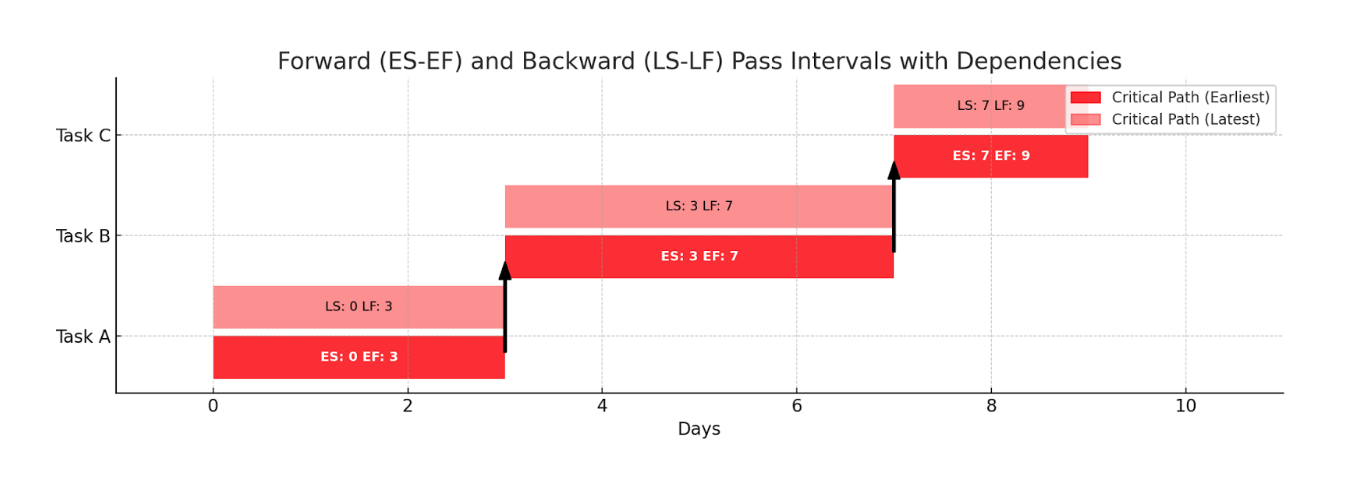
Since all tasks have zero float, they all lie on the critical path.
This simple example shows how the forward and backward passes help identify the tasks that directly impact the project timeline.
Visualizing the Critical Path for Better Communication
Visual tools bring critical path analysis in project management to life and make it accessible for all stakeholders. Clear visuals facilitate understanding and improve project coordination.
Common Visualization Tools
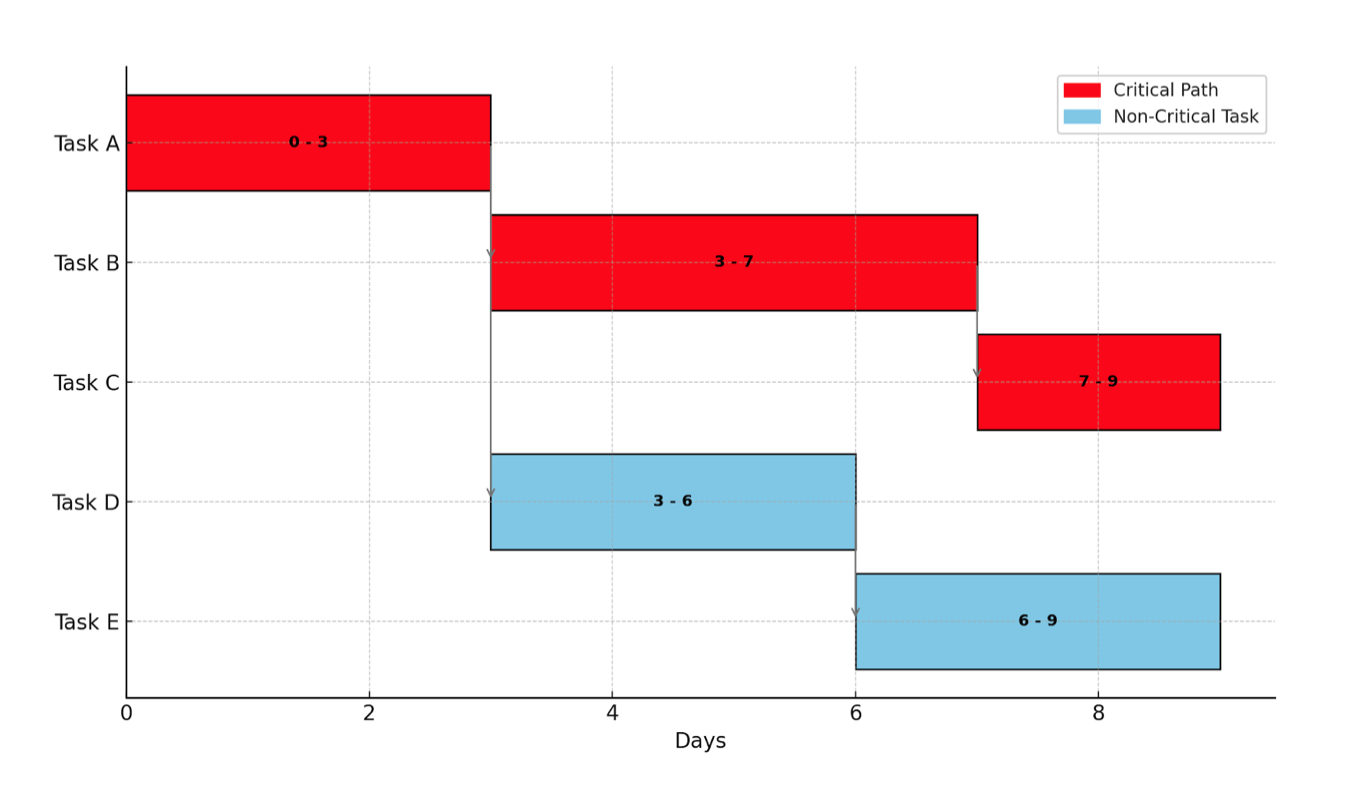
- Gantt Charts: Horizontal bar charts showing task durations and dependencies. Critical path tasks can be highlighted in distinct colors for immediate visibility.
- PERT/Network Diagrams: Graphical representations where tasks are nodes connected by dependency arrows. The critical path is often emphasized to distinguish it.
Benefits of Visualization
- Improves stakeholder understanding of project status and priorities.
- Helps teams quickly identify critical tasks and plan their work accordingly.
- Supports dynamic updates and communication in modern project management tools.
Common Challenges and Mistakes in Critical Path Analysis in Project Management
Even experienced project managers can encounter pitfalls when applying critical path analysis in project management. Being aware of these common mistakes helps ensure the analysis remains accurate and actionable.
One frequent mistake is ignoring task dependencies. Overlooking how tasks logically relate to one another can lead to inaccurate project schedules and missed bottlenecks, causing unforeseen delays.
Another issue is not updating the critical path regularly. Projects often evolve, and failing to revise the critical path accordingly results in outdated plans that don’t reflect current realities, leading to missed delays and poor decision-making.
Overlooking float, or the available slack time in tasks, is also common. When project managers neglect float, they may misjudge the flexibility within the schedule, causing inefficient use of resources and potential conflicts.
Finally, poor communication about critical path priorities can cause teams to waste effort on non-critical activities. Without clear understanding of which tasks are time-sensitive, resources are not focused where they are needed most, reducing overall project efficiency.
Being mindful of these challenges helps keep critical path analysis in project management a reliable and effective project management tool.
Applying Critical Path Analysis in Project Management to Resource Scheduling and Team Collaboration
Critical path analysis in project management is not just about timelines, it directly supports smarter resource management and collaboration. Successfully managing overlapping assignments and shifting priorities requires strong multitasking skills to keep projects running smoothly.
- Strategic Resource Allocation: Concentrate your resources on critical tasks to prevent delays. CPA highlights where bottlenecks might form so you can deploy resources proactively.
- Coordinated Team Efforts: Teams focusing on critical tasks increase efficiency and avoid working on activities that won’t impact the project deadline.
- Preventing Conflicts: By identifying overlapping resource needs in critical tasks, managers can reschedule or reassign work to avoid conflicts or overbooking.
- Real-Time Adaptation: Dynamic scheduling platforms that incorporate CPA allow teams to respond to changes immediately, adjusting resources as priorities shift.
For example, if two critical tasks require the same specialist simultaneously, CPA helps prioritize which task to address first, maintaining overall project flow.
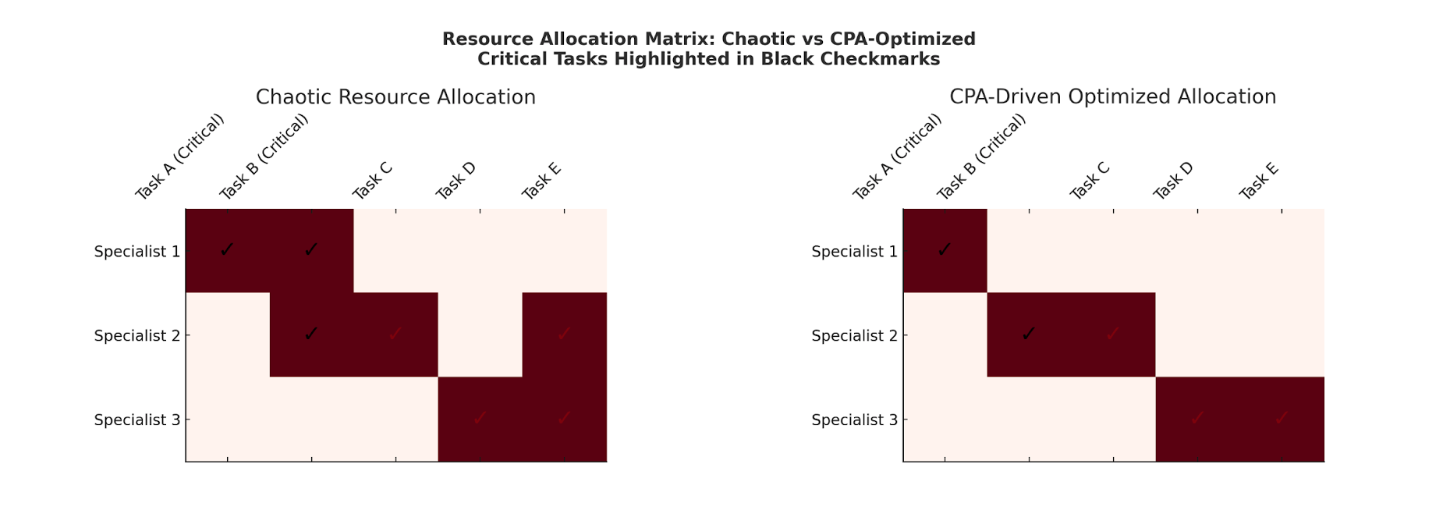
Here is the resource allocation matrix comparison:
Left: Chaotic allocation with overlapping assignments and conflicts, especially on critical tasks (Task A and Task B both assigned to Specialist 1 simultaneously).
Right: CPA-driven optimized allocation, where critical tasks get exclusive priority, avoiding conflicts and overbooking.
Critical tasks are marked with black checkmarks, non-critical with dark red.
This clearly illustrates how applying critical path analysis improves resource scheduling and team collaboration by focusing on critical tasks and reducing conflicts.
When to Reassess the Critical Path
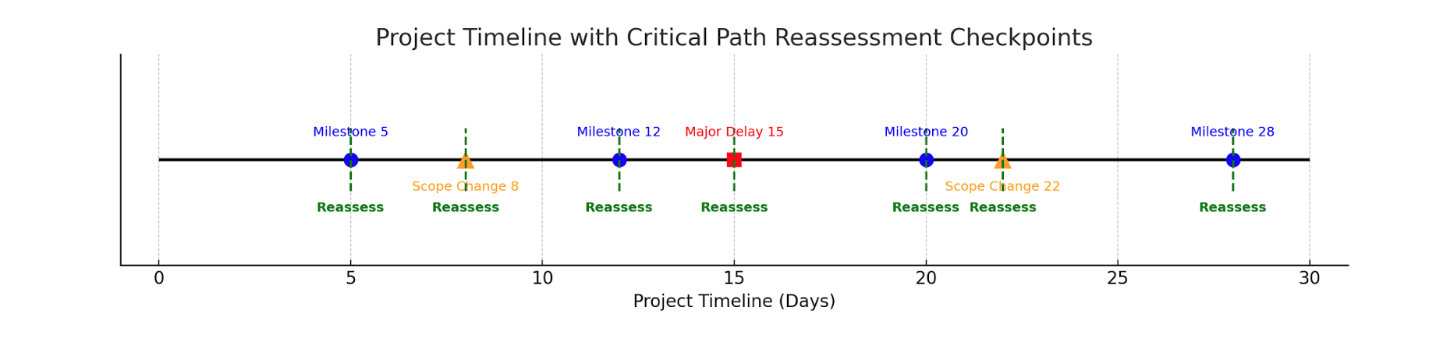
The critical path isn’t fixed once identified. It needs ongoing monitoring and updating, especially when:
- Task durations change due to delays or accelerations.
- New tasks or dependencies emerge due to scope changes.
- Resource availability fluctuates.
- Project scope evolves.
Regular reassessment ensures your project timeline reflects current realities, preventing surprises and cascading delays.
Advanced Considerations in Critical Path Analysis in Project Management
For complex projects, understanding advanced CPA aspects adds value:
- Multiple Critical Paths: When more than one path has zero float, delays in any path can impact project delivery. These require balanced monitoring.
- CPA in Agile or Hybrid Frameworks: Though Agile is iterative, CPA concepts help in sprint planning and identifying priority sequences within backlogs.
- Risk Management Integration: CPA combined with buffers and contingency plans helps absorb uncertainties without derailing the project.
Mastering these concepts equips project managers to handle diverse environments and challenges.
Benefits of Mastering Critical Path Analysis in Project Management
Mastering CPA empowers project leaders to:
- Consistently meet deadlines with better foresight.
- Communicate project progress clearly and transparently.
- Mitigate risks through proactive planning.
- Optimize resources for maximum productivity.
- Foster confident, data-driven decision-making across teams.
CPA is foundational to effective project leadership in today’s dynamic environments.
Conclusion
Critical path analysis in project management is more than a scheduling tool; it is a strategic approach that underpins timely delivery and resource efficiency. By understanding and applying CPA, project managers can confidently navigate complex projects, prioritize effectively, and keep teams aligned toward success.
Integrating CPA insights with dynamic scheduling platforms supports real-time decision-making and agile responses to change, crucial for today’s fast-paced project environments.